

EC Chairman Justice Simon Byabakama is seen addressing a Press Conference.Photo by Ronald Kabuubi/KMA Updates.
The Electoral Commission (EC) has provided a detailed update on the ongoing nomination process for Uganda’s 2026 general elections, urging candidates, political parties, and stakeholders to strictly adhere to the law as the country moves closer to campaigns and polling.
Speaking at a press briefing in Kampala, EC Chairman Justice Simon Byabakama said the nomination process began on September 3 with district and city chairpersons, Lord Mayors, councillors, and representatives of special interest groups. He confirmed that this first phase concluded on September 5.
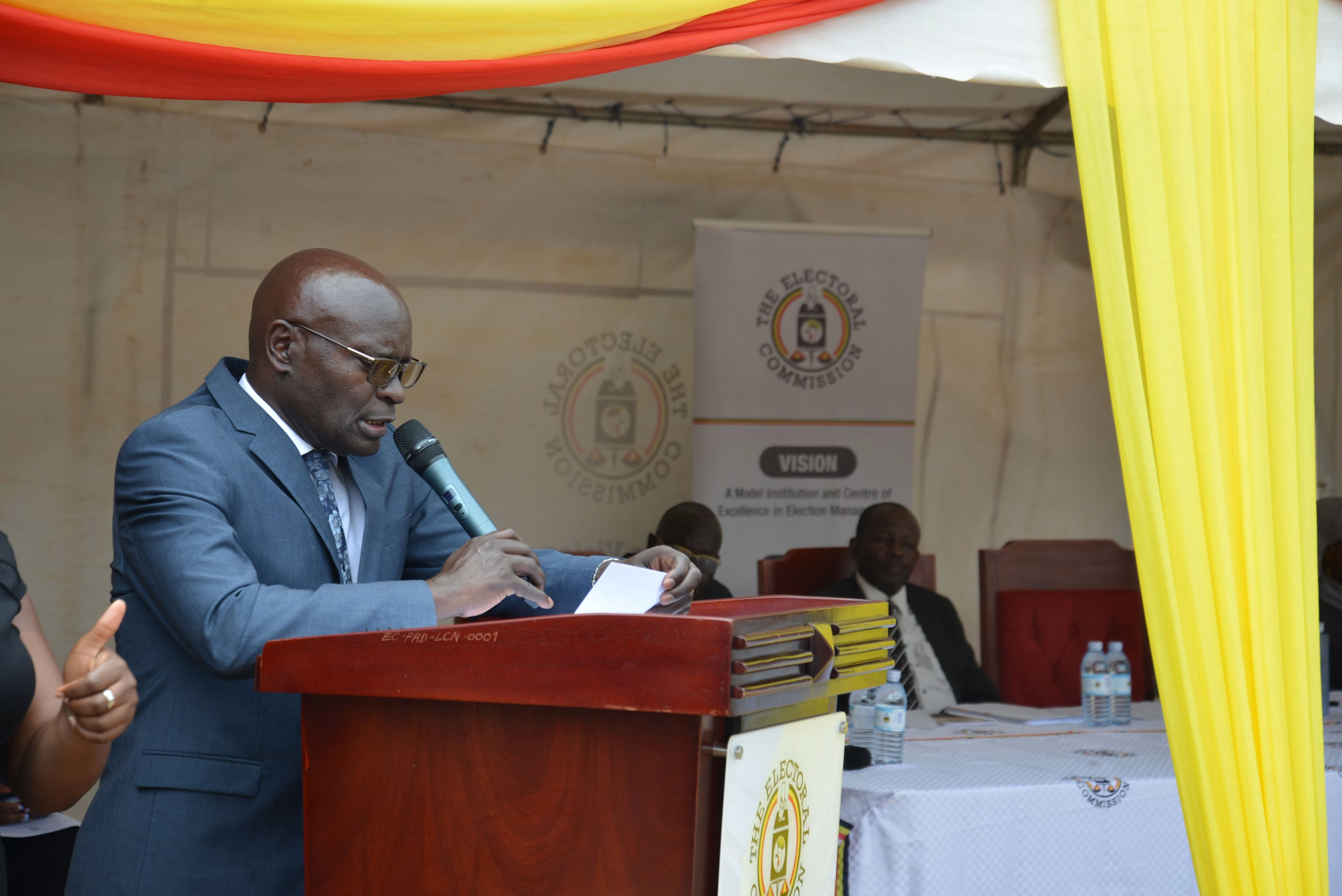
EC Chairman Justice Simon Byabakama is seen addressing a Press Conference.Photo by Ronald Kabuubi/KMA Updates.
The second phase, covering municipality and city division chairpersons and councillors—including special interest groups—commenced on September 8 and will run until September 10 at gazetted district and city nomination centres. The third phase, for sub-county, town, and municipal division chairpersons and councillors, is scheduled from September 11 to 24 at designated county centres.
Justice Byabakama described the nomination of presidential candidates as a “critical milestone on the electoral roadmap,” scheduled for September 23–24 at the EC’s proposed headquarters in Lubowa, Entebbe Road. He acknowledged that while infrastructure at the venue is still under development, preparations are ongoing to ensure a smooth and successful process.
The EC chairman congratulated candidates who have completed nominations so far but warned against flouting rules. He reminded aspirants that complaints must be submitted officially in writing to the EC rather than aired on social media, emphasizing that formal petitions enable the commission to investigate and take appropriate action.
Key nomination requirements include:
-
Payment of non-refundable fees before nomination.
-
Allocation of symbols on a first-come, first-served basis for independents; party flag bearers automatically use the party symbol.
-
Withdrawal procedures through written notification signed by the candidate and witnessed by two registered voters; party-sponsored withdrawals require ratification by the party secretary general or authorized official.
- Byakama also urged aspirants to ensure that they meet the requirements needed by the Commission, like paying of the nomination fees prior to going for nomination. Concerning independent candidates, he said that the symbols gazetted by the Commission will be allocated on a first come, first serve basis.Concerning the nomination of presidential candidates which is slated for 23th and 24th September 2025, at the proposed Electoral Commission headquarters in Lubowa Lweza, Byabakama said that aspirants will be allowed to move with a convoy of only two vehicles carrying twenty people in total, and guided by security.
Justice Byabakama also outlined campaign and convoy rules, noting that any vehicle convoy for nominations must not exceed two vehicles, each bearing police stickers and carrying no more than ten persons.
To support candidates and the public, the EC has established a complaints and queries desk at its headquarters, with toll-free numbers 0800 300121 and 0800 300122 available for inquiries. Additionally, there are lines for verifying aspirants and supporters on the National Voters Register.
Presidential candidates must meet stringent legal criteria:
-
Be a citizen of Uganda by birth, a registered voter, and at least 18 years old.
-
Hold a minimum qualification of Advanced Level or equivalent, with foreign qualifications certified by the National Council for Higher Education and UNEB at least two months before nomination.
-
Be seconded by at least 100 registered voters from not less than 80 districts, with lists of supporters submitted by September 10 to allow verification.
Justice Byabakama concluded by urging all Ugandans to uphold peace and discipline throughout the electoral process. “We should not allow elections to disrupt the prevailing peace and stability in our country, which are critical for socio-economic transformation. I say this for God and my country,” he said.
He issued a stern warning against voter bribery, emphasizing that attempting to influence voters with money is illegal and can lead to prosecution, annulment of election results, and legal challenges. Switching briefly into Luganda, he cautioned: “Banange, bano bulwadde buli mu kulonda, tulina okubulwanyisa”—underscoring the seriousness of electoral integrity.
As Uganda progresses toward the 2026 elections, the EC stresses that adherence to legal guidelines, peaceful conduct, and transparency remain vital for credible and inclusive polls.
The next segment will run from September 11 to 24 for sub-county, town, and municipal division chairpersons and councillors. All nominations will be conducted at designated county centres.
Justice Byabakama stressed that the nomination of presidential candidates, which he described as “a critical milestone on the electoral roadmap,” will be held on September 23 and 24 at the EC’s proposed headquarters in Lubowa, Entebbe road. “Although in terms of infrastructure there isn’t much as yet, we felt it prudent to conduct this key milestone at the same site where the EC home will be set up. Work is ongoing to prepare the venue appropriately so that we can have very successful nominations,” he assured.
The EC boss congratulated all candidates who have so far been successfully nominated for local government positions, but warned against flouting the commission’s guidelines. “We urge all stakeholders involved in the process to abide by the rules as we transition to the next phase of the electoral process, namely campaigns,” he said.
Byabakama also addressed growing concerns about complaints being aired on social media. “The Commission has already received a number of petitions arising out of the processes conducted so far. However, we have observed that some participants have resorted to using various media platforms to raise allegations of irregularities. We wish to emphasize that such platforms are not the appropriate channels. Any individual or entity with a complaint should submit it officially, particularly in writing to the Electoral Commission, to enable us to examine the matter and determine the appropriate course of action,” he cautioned.
He further reminded aspirants about key requirements for nomination, including the payment of non-refundable fees before nomination day and the allocation of symbols. “Symbols will be allocated on a first-come, first-serve basis. If a candidate is a party flag bearer, automatically the symbol is the party symbol. For independents, they must choose from among the 20 gazetted symbols, and sign against the one allocated to them before leaving the nomination centre,” he explained.
The EC also clarified procedures on withdrawal of candidates, which must be done through a written notification signed by the candidate and witnessed by two registered voters of the electoral area. For party-sponsored candidates, withdrawal must be ratified by the party secretary general or a duly authorized official.
The nomination for Members of Parliament will take place between 15th and 16th October at the various cities, district, and municipality returning offices across the country.